<?xml version="1.0" encoding="UTF-8"?>
<?xml-stylesheet type="text/xsl" href="/stylesheets/feed.atom.xml" media="screen"?>
<feed xml:lang="en-US" xmlns="http://www.w3.org/2005/Atom">
  <id>tag:sai.nd.edu,2005:/news</id>
  <link rel="alternate" type="text/html" href="https://sai.nd.edu"/>
  <link rel="self" type="application/atom+xml" href="https://sai.nd.edu/news.atom"/>
  <id>tag:sai.nd.edu,2005:/latest</id>
  <title>Scientific Artificial Intelligence (SAI) Initiative | News</title>
  <updated>2026-07-14T10:39:00-04:00</updated>
  <link rel="alternate" type="text/html" href="https://sai.nd.edu/"/>
  <link rel="self" type="application/atom+xml" href="https://sai.nd.edu//news.atom"/>
  <subtitle>The Scientific AI Initiative connects researchers across campus, aiming to expand Notre Dame's resources and expertise around scientific AI.</subtitle>
  <entry>
    <id>tag:sai.nd.edu,2005:News/183060</id>
    <published>2026-07-14T10:39:00-04:00</published>
    <updated>2026-07-14T11:15:00-04:00</updated>
    <link rel="alternate" type="text/html" href="https://sai.nd.edu/news/sai-launches-data-extraction-community-projects-to-boost-domain-legibility-for-ai/"/>
    <title>SAI Launches Data Extraction Community Projects to Boost Domain Legibility for AI</title>
    <summary type="text">
      <![CDATA[Founding projects in chemical reaction data, polymer data extraction, infectious disease, and data digitization will bring Notre Dame researchers together to make disciplinary information usable by AI. …]]>
    </summary>
    <content type="html">
      <![CDATA[<p><em>Founding projects in chemical reaction data, polymer data extraction, infectious disease, and data digitization will bring Notre Dame researchers together to make disciplinary information usable by AI.</em></p>
<figure class="image image-right"><img src="https://sai.nd.edu/assets/666190/dac_sai_dataextractionproj_6.jpg" alt="Two men examine a computer monitor displaying a data plot in an office. One wears a Notre Dame polo, the other a plaid shirt." width="600" height="428"></figure>
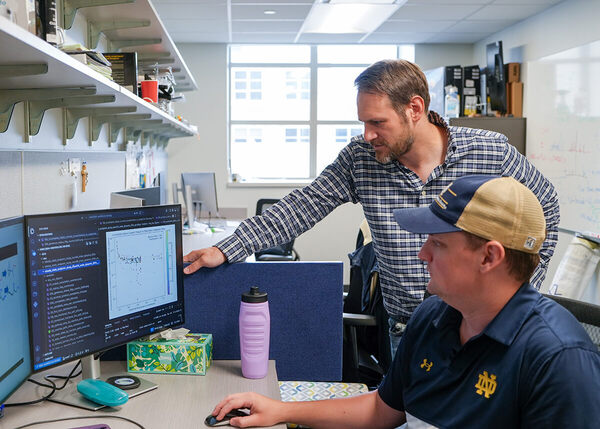
<p>The University of Notre Dame's <a href="https://sai.nd.edu/">Scientific Artificial Intelligence (SAI) Initiative</a> has launched a set of community projects focused on the central obstacle to using AI in specialized research: most disciplinary knowledge was never organized for machines to read.</p>
<p>Academic publications are formatted for human reading rather than machine ingestion. Raw measurements may be difficult to reconstruct from text alone or placed in unstructured supporting files. Similarly, disciplinary representations and reporting conventions can also hide essential context from a machine such as the conditions of an experiment or standard conventions for plotting results, even when the meaning is clear to an expert reader. The result is that critical information for applying AI to pressing research problems remains effectively out of bounds for contemporary systems.</p>
<p>Groups across Notre Dame are already solving parts of this problem in their own domains. The community projects will connect that work so that each group does not independently rebuild the same extraction machinery. A parsing workflow developed for one literature may contain components that transfer to another, while domain experts determine what information matters and what evidence is needed to interpret it.</p>
<figure class="image image-left"><img src="https://sai.nd.edu/assets/666191/dac_sai_dataextractionproj_4.jpg" alt="A bearded man in a blue plaid shirt gestures as he speaks to two younger men walking with him in a hallway." width="600" height="428">
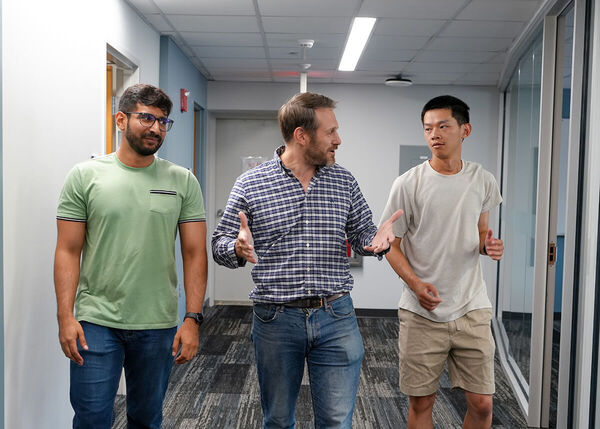
<figcaption>Brett Savoie, director of the SAI Initiative and the Coyle Mission Collegiate Professor of Engineering with graduate students Yun-Ke Liu and Bryan Piguave</figcaption>
</figure>
<p>One founding project illustrates this combination. <a href="https://engineering.nd.edu/faculty/brett-savoie/">Brett Savoie</a>, director of the SAI Initiative and the Coyle Mission Collegiate Professor of Engineering, is working with students Yun-Ke Liu and Bryan Piguave to extract chemical reaction data from the scientific literature.</p>
<p>Reaction data is a bottleneck for applications in drug discovery, materials synthesis, and advanced chemical manufacturing. Determining how to make a molecule of interest remains a fundamental barrier in chemistry, yet relatively little of the field's accumulated knowledge of reactions are available in a form that can be used directly by AI systems.</p>
<p>Chemical structures are commonly embedded as graphics that machines cannot natively interpret. Reaction definitions, conditions, limitations, and characterization may be scattered across figures, tables, experimental sections, and supporting information. Existing datasets reflect these constraints. Some are generated heuristically from reaction templates, while others contain structures without enough context to interpret a reported transformation.</p>
<figure class="image image-right"><img src="https://sai.nd.edu/assets/666192/dac_sai_dataextractionproj_79.jpg" alt="Eight diverse men, some with beards or glasses, stand smiling in casual clothes against a blue-gray wall." width="600" height="338">
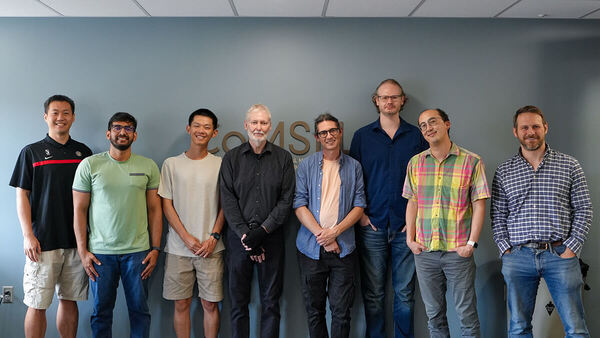
<figcaption>Notre Dame faculty Meng Jiang, Brett Savoie and Chris Sweet with graduate students of the Savoie Research Group</figcaption>
</figure>
<p>The <a href="https://savoie-research-group.github.io/people.html">Savoie Research Group </a>is developing a systematic alternative whose goal is to curate data for every standard chemical reaction class reported in the literature. Liu and Piguave are building specialized workflows based on vision-language models to locate reaction information across the textual and visual formats used in publications and assemble each reaction with its context into consistent records. Unlocking this reaction information could be transformational for ongoing drug development efforts where making molecules of interest is still often the bottleneck.</p>
<p>The data extraction community projects are expected to continue through the summer and fall semester. Participation is open to all experience levels, with several core projects led by teams with experience in this area and new projects being launched. Notre Dame faculty, students, postdoctoral researchers, and staff who are developing extraction workflows, working with difficult domain data, or interested in contributing to a founding project are invited to participate. To join, contact Laura Kresnak at lkresnak@nd.edu.</p>]]>
    </content>
    <link rel="enclosure" type="image/jpeg" href="https://sai.nd.edu/assets/666192/dac_sai_dataextractionproj_79.jpg" title="Eight diverse men, some with beards or glasses, stand smiling in casual clothes against a blue-gray wall."/>
    <author>
      <name>Brett Savoie</name>
    </author>
  </entry>
  <entry>
    <id>tag:sai.nd.edu,2005:News/180810</id>
    <published>2026-04-15T10:17:00-04:00</published>
    <updated>2026-04-15T10:18:09-04:00</updated>
    <link rel="alternate" type="text/html" href="https://sai.nd.edu/news/first-notre-dame-pontificia-universidad-catolica-de-chile-sai-winter-school-launches-in-santiago/"/>
    <title>First Notre Dame - Pontificia Universidad Catolica de Chile SAI Winter School Launches in Santiago</title>
    <summary type="text">
      <![CDATA[The University of Notre Dame and Pontificia Universidad Catolica de Chile (UC Chile) held the first ND-UC Chile Winter School for Scientific Artificial Intelligence (SAI) in Santiago in January 2026, launching a new international training model to develop research and training opportunities at the…]]>
    </summary>
    <content type="html">
      <![CDATA[<p>The University of Notre Dame and Pontificia Universidad Catolica de Chile (UC Chile) held the first ND-UC Chile Winter School for Scientific Artificial Intelligence (SAI) in Santiago in January 2026, launching a new international training model to develop research and training opportunities at the interface of artificial intelligence and science and engineering between the two schools.</p>
<figure class="image image-right"><img src="https://sai.nd.edu/assets/656155/2016_chile_31jpg.jpg" alt="Mar. 7, 2016; Pontificia Universidad Catolica de Chile. (Photo by Matt Cashore/University of Notre Dame)" width="600" height="289"></figure>
<p>Hosted by Notre Dame’s <a href="https://sai.nd.edu/">Scientific Artificial Intelligence Initiative</a> within the <a href="https://strategicframework.nd.edu/initiatives/data-ai-computing/">Data, AI, and Computing Initiative</a> at UC Chile's San Joaquin campus, the inaugural program was structured as a three-day format, including two days of lectures and hands-on tutorials followed by a third day split between a student hackathon and a faculty workshop.</p>
<p>The winter school <a href="https://sai.nd.edu/programs/sai-winter-schools/">model</a> is designed to connect classroom learning with research application, while creating a pipeline between undergraduate training, summer research, and doctoral study. The model fosters three linked goals: strengthening student exchange between the universities, providing doctoral fellows with meaningful teaching and mentorship experience, and accelerating cross-institution research collaboration through follow-on projects.</p>
<p>As the inaugural event, the Chile program <a href="https://sai.nd.edu/news/growing-winter-school-strengthens-scientific-ai-collaboration-between-notre-dame-and-university-of-puerto-rico/">extends</a> the SAI winter school concept from the University of Puerto Rico (UPR) at Mayaguez (RUM).</p>
<p>Across the school, Notre Dame faculty and SAI fellows delivered ten presentations on SAI opportunities and persistent technical bottlenecks in their fields. The program also included practical tutorials in scikit-learn and PyTorch, plus applied sessions on methods such as featurization, transformers, and flow matching for scientific use cases. A poster session and reception on day one created an additional venue for participant exchange across institutions.</p>
<p>Notre Dame participants included <a href="https://engineering.nd.edu/faculty/brett-savoie/">Brett Savoie</a>, the Coyle Mission Collegiate Professor of Engineering, Chemical and Biomolecular Engineering and SAI Initiative director, <a href="https://engineering.nd.edu/faculty/diego-gomez-zara/">Diego Gomez-Zara</a>, assistant professor in the Department of Computer Science and Engineering, <a href="https://engineering.nd.edu/faculty/alexandros-taflanidis/">Alex Taflanidis</a>, professor of Civil and Environmental Engineering and Earth Sciences and director of graduate studies for Civil and Environmental Engineering, <a href="https://engineering.nd.edu/faculty/robert-nerenberg/">Robert Nerenberg</a>, professor of Civil and Environmental Engineering and Earth Sciences, <a href="https://engineering.nd.edu/faculty/diogo-bolster/">Diogo Bolster</a>, the Frank M. Freimann Professor of Hydrology and Henry Massman Department Chair for the department of Civil and Environmental Engineering and Earth Sciences, and <a href="https://lucyinstitute.nd.edu/people/the-lucy-family-core-team/fanny-ye/">Fanny Ye</a>, associate director of applied analytics for the Lucy Family Institute for Data &amp; Society and Galassi Family Collegiate Professor in Computer Science and Engineering.</p>
<p>Graduate fellows from the SAI initiative also contributed, including Andrew Schofield, Shashank Ramesh, and Joey Farmer. The event was organized in collaboration with UC Chile engineering faculty Juan Montes and Felipe Gomez Caro.</p>
<p>The third day expanded beyond technical instruction into institutional planning. Student teams advanced hackathon projects and presented outcomes in a joint closing session, while faculty working groups developed shared priorities in AI education and research. Sessions focused on AI literacy for domain scientists and engineers, AI-enhanced pedagogy, data infrastructure and standards, and domain-specific research challenges, followed by proposal-oriented small group work.</p>
<p>The school also drew leadership participation from UC Chile and Notre Dame's Santiago network. Engineering Dean Loreto Valenzuela participated alongside other university leaders, and Juan Esteban Montes, director of Notre Dame's Santiago location, joined the broader engagement around partnership development.</p>
<p>With the Santiago launch complete, organizers now have a working template for recurring ND-UC Chile SAI programming. Applications for next year’s program are expected to come in the Fall.</p>
<p>To learn more about the SAI Initiative’s winter schools, please visit <a href="sai.nd.edu">sai.nd.edu</a>.</p>]]>
    </content>
    <link rel="enclosure" type="image/jpeg" href="https://sai.nd.edu/assets/656155/2016_chile_31jpg.jpg" title="Mar. 7, 2016; Pontificia Universidad Catolica de Chile. (Photo by Matt Cashore/University of Notre Dame)"/>
    <author>
      <name>Brett Savoie</name>
    </author>
  </entry>
  <entry>
    <id>tag:sai.nd.edu,2005:News/180172</id>
    <published>2026-03-20T11:07:00-04:00</published>
    <updated>2026-03-20T11:07:56-04:00</updated>
    <link rel="alternate" type="text/html" href="https://sai.nd.edu/news/growing-winter-school-strengthens-scientific-ai-collaboration-between-notre-dame-and-university-of-puerto-rico/"/>
    <title>Growing winter school strengthens scientific AI collaboration between Notre Dame and University of Puerto Rico</title>
    <summary type="text">
      <![CDATA[Presentations at the University of Puerto Rico (UPR) at Mayaguez (RUM) as part of the 2026 Winter Schools program with the University of Notre…]]>
    </summary>
    <content type="html">
      <![CDATA[<figure class="image image-right"><img src="https://sai.nd.edu/assets/653258/upr_nd_winterschool2026.jpg" alt="UPR ND Winter School 2026" width="600" height="428">
<figcaption>Presentations at the University of Puerto Rico (UPR) at Mayaguez (RUM) as part of the 2026 Winter Schools program with the University of Notre Dame</figcaption>
</figure>
<p>The University of Puerto Rico (UPR) at Mayaguez (RUM) hosted the <a href="https://www.sanjuandailystar.com/post/rum-hosts-academic-meeting-on-artificial-intelligence">second</a> annual UPR-University of Notre Dame Winter School for Scientific Artificial Intelligence (SAI) in <a href="https://newsismybusiness.com/upr-mayaguez-hosts-second-ai-winter-school-with-notre-dame/">January 2026</a>, continuing a collaboration that launched with the first edition in 2025 at UPR Bayamon.</p>
<p>Designed as a joint academic program between Notre Dame and the UPR system, the winter school has become a focused venue for developing AI capacity in science and engineering while strengthening institutional ties.</p>
<p>The <a href="https://sai.nd.edu/programs/sai-winter-schools/">winter school model</a>, hosted by Notre Dame’s <a href="https://sai.nd.edu/">Scientific Artificial Intelligence Initiative</a> within the <a href="https://strategicframework.nd.edu/initiatives/data-ai-computing/">Data, AI, and Computing Initiative</a>, combines survey-style research talks with hands-on, stand-alone technical training. This year's program included tutorials in scikit-learn and PyTorch, topic lectures from Notre Dame and UPR faculty, and an applied research focus on how AI methods can be used in scientific and engineering workflows. The event also connects high-performing UPR students to future research and graduate training opportunities at ND.</p>
<p>The Mayaguez program reflected clear year-over-year growth. In addition to two days of lectures and tutorials, the event expanded to include a third day with parallel tracks, including a student hackathon and a faculty strategy workshop on SAI education and research. The student track included four hackathon teams, with mentors from the SAI graduate fellowship program at the University of Notre Dame supporting project development and final presentations. A poster session and reception added another venue for students and faculty to discuss ongoing work.</p>
<figure class="image image-left"><img src="https://sai.nd.edu/assets/653257/upr_nd_winterschool2026_2.jpg" alt="UPR ND Winter School 2026, Tengfei Luo presentation" width="600" height="428">
<figcaption>Tengfei Luo, the Dorini Family Professor for Energy Studies and associate department chair, Aerospace and Mechanical Engineering presented at the second annual UPR-University of Notre Dame Winter School for Scientific Artificial Intelligence (SAI) in January 2026</figcaption>
</figure>
<p>Notre Dame faculty and SAI fellows delivered ten presentations across the program. Participating Notre Dame faculty included:</p>
<ul>
<li dir="ltr" aria-level="1">
<p><a href="https://engineering.nd.edu/faculty/yamil-j-colon/">Yamil Colon</a>, associate professor, Chemical and Biomolecular Engineering</p>
</li>
<li dir="ltr" aria-level="1">
<p><a href="https://engineering.nd.edu/faculty/meng-jiang/">Meng Jiang</a>, the Frank M. Freimann Collegiate Professor of Computer Science and Engineering and associate professor, Computer Science and Engineering</p>
</li>
<li dir="ltr" aria-level="1">
<p><a href="https://engineering.nd.edu/faculty/tengfei-luo/">Tengfei Luo</a>, the Dorini Family Professor for Energy Studies and associate department chair, Aerospace and Mechanical Engineering</p>
</li>
<li dir="ltr" aria-level="1">
<p><a href="https://engineering.nd.edu/faculty/brett-savoie/">Brett Savoie</a>, the Coyle Mission Collegiate Professor of Engineering, Chemical and Biomolecular Engineering and SAI Initiative director</p>
</li>
<li dir="ltr" aria-level="1">
<p><a href="https://engineering.nd.edu/faculty/james-schmiedeler/">Jim Schmiedeler</a>, professor of Aerospace and Mechanical Engineering and associate dean for faculty advancement and inclusion</p>
</li>
<li dir="ltr" aria-level="1">
<p><a href="https://engineering.nd.edu/faculty/alexandros-taflanidis/">Alex Taflanidis</a>, professor of Civil and Environmental Engineering and Earth Sciences, director of graduate studies for Civil and Environmental Engineering</p>
</li>
<li dir="ltr" aria-level="1">
<p><a href="https://acms.nd.edu/people/tiffany-tang/">Tiffany Tang</a>, the Clare Boothe Luce Assistant Professor of Applied Statistics, Bioinformatics and Biostatistics, Scientific Computing and Statistical Machine Learning</p>
</li>
<li dir="ltr" aria-level="1">
<p><a href="https://engineering.nd.edu/faculty/tim-weninger/">Tim Weninger</a>, associate professor of Computer Science and Engineering and director of graduate studies for Computer Science and Engineering</p>
</li>
</ul>
<p>SAI fellows Orlando Mendible Barreto, Jichuan Tang, and Hao Chen also contributed to tutorials and technical sessions. The event was organized in collaboration with UPR Mayaguez faculty Ubaldo M. Cordova Figueroa and Hansel Montalvo Castro.</p>
<p>A notable outcome of the 2026 edition was participation from senior UPR leadership in the strategic workshop, including UPR President Zayira Jordan Conde who opened the third day with welcoming remarks, RUM Chancellor Agustin Rullan Toro, UPR Executive Vice President for Academic Affairs and Research Wilma Santiago Gabrielini, and College of Engineering Dean Cristina Pomales.</p>
<p>The winter school's momentum also aligns with a broader education pathway between Notre Dame and Puerto Rico, supported by the Kinesis Foundation. Kinesis, a Puerto Rico-based education nonprofit, traces its Notre Dame connection to a scholarship fund established in 1984 by Jose Enrique Fernandez for Puerto Rican students at Notre Dame. Today, that relationship continues through the Kinesis-Fernandez Richards Family Fellowship at Notre Dame's Graduate School, which supports graduate study for U.S. citizens from Puerto Rico.</p>
<p>Together, the winter school and related talent-development programs are creating a durable bridge between UPR and Notre Dame that links classroom training, research collaboration, and graduate recruitment across institutions.</p>
<p>To learn more about the SAI Initiative’s winter schools, please visit the sai.nd.edu.</p>]]>
    </content>
    <link rel="enclosure" type="image/jpeg" href="https://sai.nd.edu/assets/653258/upr_nd_winterschool2026.jpg" title="UPR ND Winter School 2026"/>
    <author>
      <name>Brett Savoie</name>
    </author>
  </entry>
  <entry>
    <id>tag:sai.nd.edu,2005:News/179624</id>
    <published>2026-03-02T12:39:00-05:00</published>
    <updated>2026-03-02T12:57:29-05:00</updated>
    <link rel="alternate" type="text/html" href="https://sai.nd.edu/news/notre-dame-to-host-international-workshop-on-polymer-data-in-washington-dc/"/>
    <title>Notre Dame to Host International Workshop on Polymer Data in Washington, DC</title>
    <summary type="text">
      <![CDATA[The University of Notre Dame will host the International Workshop on Polymer Data (IWPD) on March 5-6, 2026, at the University of Notre Dame Washington, DC office. The two-day workshop convenes faculty, industry leaders, and national laboratory stakeholders…]]>
    </summary>
    <content type="html">
      <![CDATA[<p>The University of Notre Dame will host the <a href="https://polymerdataworkshop.nd.edu/">International Workshop on Polymer Data (IWPD)</a> on March 5-6, 2026, at the University of Notre Dame Washington, DC office. The two-day workshop convenes faculty, industry leaders, and national laboratory stakeholders from across the country to accelerate data-driven polymer science.</p>
<p>The workshop is organized by Notre Dame’s <a href="https://engineering.nd.edu/faculty/tengfei-luo/">Tengfei Luo</a> the Dorini Family Professor for Energy Studies and Associate Department Chair in the College of Engineering and <a href="https://engineering.nd.edu/faculty/brett-savoie/">Brett Savoie</a>, the Coyle Mission Collegiate Professor of Engineering, Chemical and Biomolecular Engineering in the College of Engineering. Nicholas Jackson of the University of Illinois Urbana-Champaign, Junichiro Shiomi from the University of Tokyo, and Ryo Yoshida from the Institute of Statistical Mathematics in Japan also partnered with Notre Dame for the event.</p>
<p>IWPD is convened to critically assess the changes and opportunities being wrought in polymer research in light of improving capabilities in artificial intelligence (AI) and the need for high-quality data. Topics explored during the panels and working groups include building a shared, high-quality data infrastructure to support reproducible science and next-generation AI models and existing capability gaps. The program convenes experts in experiments, simulation and machine learning to advance practical standards for polymer data reporting and model documentation.</p>
<p>Participants include representatives from academia, industry, and government research organizations, with perspectives spanning polymer synthesis, characterization, simulation, and AI. The workshop also includes stakeholders connected to national lab and federal research priorities, including participants from NIST, the Air Force Research Laboratory, and Argonne National Laboratory.</p>
<p>Workshop sponsors are the <a href="https://sai.nd.edu/">Notre Dame Scientific AI Initiative</a>, <a href="https://research.nd.edu/">Notre Dame Research</a>, the <a href="https://beckman.illinois.edu/">Beckman Institute at UIUC</a>, Procter &amp; Gamble, and Avery Dennison.</p>
<p>To learn more about the workshop, please visit: <a href="https://polymerdataworkshop.nd.edu/">https://polymerdataworkshop.nd.edu/</a></p>]]>
    </content>
    <link rel="enclosure" type="image/webp" href="https://sai.nd.edu/assets/650772/banner_picture.webp" title="IWPD banner image"/>
    <author>
      <name>Brett Savoie</name>
    </author>
  </entry>
  <entry>
    <id>tag:sai.nd.edu,2005:News/173914</id>
    <published>2025-07-22T10:36:00-04:00</published>
    <updated>2025-07-22T10:44:10-04:00</updated>
    <link rel="alternate" type="text/html" href="https://sai.nd.edu/news/notre-dame-hosts-major-international-artificial-intelligence-and-machine-learning-conference/"/>
    <title>Notre Dame hosts major international artificial intelligence and machine learning conference</title>
    <summary type="text">
      <![CDATA[Experts from 22 different institutions of education and research located in 7 different countries gathered at the University of Notre Dame (South Bend, Indiana, USA) last week for a flagship workshop of the Centre Européen de Calcul Atomique et Moléculaire (CECAM).…]]>
    </summary>
    <content type="html">
      <![CDATA[<p>Experts from 22 different institutions of education and research located in 7 different countries gathered at the University of Notre Dame (South Bend, Indiana, USA) last week for a flagship workshop of the <a href="https://www.cecam.org/">Centre Européen de Calcul Atomique et Moléculaire</a> (CECAM). From July 7 to 9, 2025, the participants—who are among the world's top researchers in the development and application of artificial intelligence (AI) and machine learning for chemistry and materials discovery—gathered for presentations, a poster session, and discussions focused on machine learning advances for the prediction of molecular and material properties.</p>
<p>“This was a unique opportunity to bring together so many experts in the field from all over the world right here at Notre Dame,” said <a href="https://cbe.nd.edu/faculty/yamil-j-colon/">Yamil Colón,</a> associate professor in the <a href="https://cbe.nd.edu/">Department of Chemical and Biomolecular Engineering</a>. “Our students were able to participate in the poster sessions and share ideas with world-class peers. This week was a great moment for all of us to get together, to network, and to share science.”</p>
<p>The workshop marks only the second occasion that CECAM has convened in the United States. Founded in 1969 and headquartered in Lausanne, Switzerland, CECAM’s US-Central node was established at the University of Chicago in 2023, <a href="https://research.nd.edu/news-and-events/news/notre-dame-helps-establish-the-first-us-node-of-top-computational-modeling-network/">with Notre Dame as one of its founding partners</a>. With 21 nodes encompassing 29 institutions from 17 countries, CECAM meets regularly to share findings and best practices in computational science organized around a timely theme.</p>
<p>“Machine learning, the focus of this workshop, is revolutionizing the field of computational predictions of molecular and material properties. It has enabled recent advances like foundation models and machine learning interatomic potentials,” said Colón, who served as one of the workshop’s organizers.</p>
<p>In recent years, machine learning has become a powerful tool for predicting the properties of chemical structures and engineered materials without the need for wet lab experiments, which can be time-consuming and hazardous. Advances in computer engineering have allowed researchers to develop algorithms that can extract chemical attributes and predict properties from atomic coordinates and feature vectors. Experts have also devoted much effort to compiling large property datasets, which are critical for the training and standardizing of new frameworks.</p>
<figure class="image image-right"><img src="https://research.nd.edu/assets/623067/head2.jpg" alt="A speaker in a light gray, plaid blazer stands at a podium with two monitors, presenting to an audience in a university lecture hall." width="600" height="400">
<figcaption>Yamil Colón, associate professor in the Department of Chemical and Biomolecular Engineering at the University of Notre Dame, presents his research in a talk at the CECAM flagship workshop at the University of Notre Dame on July 9, 2025.</figcaption>
</figure>
<p>To date, machine learning models have been successfully applied to the prediction of reactive, physicochemical, and pharmacological properties of molecules and materials. Researchers have also implemented machine learning in spectroscopy, which enables the automated characterization of a variety of chemical spectra, including infrared (IR), ultraviolet and visible light (UV/vis), and nuclear magnetic resonance (NMR).</p>
<p>“Machine learning advancements open the door for accelerating chemical and materials characterization in the immediate future,” explained Colón. “With a new understanding of physical, chemical, and molecular phenomena that were once unattainable, there is high potential for the development of novel materials to address issues in energy, water security, and healthcare, as well as a new generation of drug development."</p>
<p>“This workshop facilitated a great exchange of information on the latest developments in this fast-moving research area,” said <a href="https://engineering.nd.edu/faculty/edward-maginn/">Ed Maginn</a>, associate vice president for research and Keough-Hesburgh Professor in the <a href="https://cbe.nd.edu/">Department of Chemical and Biomolecular Engineering</a>, who helped organize the workshop. “I’m very excited that Notre Dame was able to host such an exceptional group of scholars for a rich week of international collaboration in this crucial field.”</p>
<p>The workshop was made possible by financial support from CECAM as well as the following Notre Dame entities: <a href="https://precisionhealth.nd.edu/">Berthiaume Institute for Precision Health</a>; <a href="https://crc.nd.edu/">Center for Research Computing</a>; <a href="http://engineering.nd.edu">College of Engineering</a>; <a href="http://science.nd.edu">College of Science</a>; <a href="https://cbe.nd.edu/">Department of Chemical and Biomolecular Engineering</a>; <a href="https://chemistry.nd.edu/">Department of Chemistry and Biochemistry</a>; <a href="https://latinostudies.nd.edu/">Institute for Latino Studies</a>; <a href="https://lucyinstitute.nd.edu/">Lucy Family Institute for Data &amp; Society</a>; <a href="http://energy.nd.edu">ND Energy</a>; <a href="https://nano.nd.edu/">NDnano</a>; <a href="http://research.nd.edu">Notre Dame Research</a>; <a href="https://sai.nd.edu/">Scientific Artificial Intelligence Initiative</a>.</p>
<p>To learn more about machine learning and artificial intelligence research at the University of Notre Dame, please visit the <a href="https://crc.nd.edu/">Center for Research Computing</a>, <a href="https://lucyinstitute.nd.edu/">Lucy Family Institute for Data &amp; Society</a>, and <a href="https://sai.nd.edu/">Scientific Artificial Intelligence Initiative</a>.</p>
<p><strong>Contact</strong></p>
<p>Erin Fennessy / Writing Program Manager</p>
<p>Notre Dame Research / University of Notre Dame</p>
<p>efenness@nd.edu / +1 574-631-8183</p>
<p>research.nd.edu / @UNDResearch / <a href="http://linkedin.com/company/undresearch">linkedin.com/company/undresearch</a></p>
<p><strong>Photos</strong></p>
<p>Photos by Angelic Rose Hubert.</p>
<p><strong>About Notre Dame Research</strong></p>
<p>The University of Notre Dame is a private research and teaching university inspired by its Catholic mission. Located in South Bend, Indiana, its researchers are advancing human understanding through research, scholarship, education, and creative endeavor in order to be a repository for knowledge and a powerful means for doing good in the world. For more information, please visit <a href="http://research.nd.edu">NDR's website</a> or <a href="https://www.linkedin.com/company/undresearch/">NDR's LinkedIn</a>.<strong id="docs-internal-guid-f99cab69-7fff-7fe1-2eee-4168d3096e59"><br></strong></p>
<p class="attribution">Originally published by <span class="rel-author">Erin Fennessy</span> at <span class="rel-source"><a href="https://research.nd.edu/news-and-events/news/notre-dame-hosts-major-international-artificial-intelligence-and-machine-learning-conference/">research.nd.edu</a></span> on <span class="rel-pubdate">July 22, 2025</span>.</p>]]>
    </content>
    <link rel="enclosure" type="image/jpeg" href="https://sai.nd.edu/assets/623086/lead.jpg" title="A man in a plaid shirt gestures while explaining his research poster to another man at a University of Notre Dame event.  A third person looks on.  The poster includes scientific charts, diagrams, and text."/>
    <author>
      <name>Erin Fennessy Lawlor</name>
    </author>
  </entry>
  <entry>
    <id>tag:sai.nd.edu,2005:News/173022</id>
    <published>2025-06-03T11:09:53-04:00</published>
    <updated>2025-06-03T11:09:53-04:00</updated>
    <link rel="alternate" type="text/html" href="https://sai.nd.edu/news/notre-dame-announces-2025-strategic-framework-grant-recipients/"/>
    <title>Notre Dame announces 2025 Strategic Framework Grant recipients</title>
    <summary type="text">
      <![CDATA[The University of Notre Dame has announced the awardees of its 2025 Strategic Framework Grant (SFG) Program. Launched in 2024, the program is an…]]>
    </summary>
    <content type="html">
      <![CDATA[<p>The University of Notre Dame has announced the awardees of its 2025 <a href="https://research.nd.edu/our-services/funding-opportunities/faculty/internal-grants-programs/strategic-framework-internal-seed-grants/">Strategic Framework Grant (SFG) Program</a>.</p>
<p>Launched in 2024, the program is an internal funding opportunity that stimulates engagement with the priorities outlined in <a href="https://strategicframework.nd.edu/notre-dame-2033-a-strategic-framework/" target="_blank" rel="noopener nofollow noreferrer">Notre Dame 2033: A Strategic Framework</a>. The program, sponsored by the <a href="https://provost.nd.edu/">Office of the Provost</a>, <a href="https://research.nd.edu/">Notre Dame Research</a>, and <a href="https://learning.nd.edu/">ND Learning</a>, serves as a broad invitation to members of the faculty to creatively imagine ways to align their research and teaching efforts with the Strategic Framework and to support them in doing so.</p>
<p>The program drew a strong response in its second year, with research and teaching proposals from 139 faculty members representing 47 different departments, centers, and institutes across every college and school, along with units that report to the Office of Research and the Office of the Provost. The proposals also included 12 external partners from communities as close as South Bend and spanning four other continents.</p>
<p>“In its second year, the Strategic Framework Grant program is encouraging faculty to ‘think as an institution’ through collaborative, multidisciplinary research projects,” said <a href="https://provost.nd.edu/people/john-mcgreevy/">John T. McGreevy</a>, the Charles and Jill Fischer Provost and Francis A. McAnaney Professor of History at Notre Dame. “The selected projects reflect how faculty are embracing the University-wide Strategic Framework, aligning their work with Notre Dame’s priorities as a leading global Catholic research university.”</p>
<h3>Strategic Framework Research Grant</h3>
<p>The following awardees of the Strategic Framework Research Grant will receive funding to support new and novel outstanding research and/or creative endeavors that advance Notre Dame’s scholarship in alignment with the priorities of the framework.</p>
<p><a href="https://biology.nd.edu/people/ryan-l-sensenig/">Ryan Sensenig</a>, a professor of the practice in the Department of Biological Sciences, will lead a research project titled “Interactive effects of fire and grazing on carbon accumulation in grasslands: the role of microbial biomass and necromass.” Sensenig will be joined by co-principal investigator <a href="https://engineering.nd.edu/faculty/melissa-berke/">Melissa Berke</a>, an associate professor in the <a href="https://ceees.nd.edu/">Department of Civil and Environmental Engineering and Earth Sciences</a>.</p>
<p><a href="https://sociology.nd.edu/people/daniel-tadmon/">Daniel Tadmon</a>, an assistant professor in the <a href="https://sociology.nd.edu/">Department of Sociology</a> with an affiliation with the <a href="https://lucyinstitute.nd.edu/">Lucy Family Institute for Data &amp; Society</a>, and <a href="https://sociology.nd.edu/people/molly-copeland/">Molly Copeland</a>, an assistant professor in the Department of Sociology, will lead a research project titled “Novel Empirical Approaches to Examine Spatial-Social Integration and Suicide.”</p>
<p><a href="https://keough.nd.edu/about/faculty-staff-directory/manuel-alejandro-estefan-davila/">Alejandro Estefán Dávila</a>, an assistant professor of development economics at the <a href="https://keough.nd.edu/">Keough School of Global Affairs</a>, and co-principal investigator Enrique Seira Bejarano, the incoming Joe and Deborah Loughrey Professor of Economics and Human Development in the <a href="https://economics.nd.edu/">Department of Economics</a>, will lead a research project titled “Civic Education and Democratic Citizenship: A Multisite Randomized Intervention.”</p>
<p><a href="https://engineering.nd.edu/faculty/paola-crippa/">Paola Crippa</a>, an assistant professor in the <a href="https://ceees.nd.edu/">Department of Civil and Environmental Engineering and Earth Sciences</a>, <a href="https://kroc.nd.edu/faculty-and-staff/richard-drew-marcantonio/">Richard “Drew” Marcantonio</a>, assistant professor of environment, peace and global affairs at the <a href="https://kroc.nd.edu/">Kroc Institute for International Peace Studies</a>, and <a href="https://gain.nd.edu/about/team/danielle-wood/">Danielle Wood</a>, director of the <a href="https://gain.nd.edu/">Notre Dame Global Adaptation Initiative</a>, are co-leading a research project titled “Transformative Solutions for a Global Health Crisis: A Novel Urban Air Quality Strategy.”</p>
<p><a href="https://engineering.nd.edu/faculty/yanfang-fanny-ye/">Fanny Ye</a>, Galassi Family Collegiate Professor in Computer Science and Engineering in the <a href="https://cse.nd.edu/">Department of Computer Science and Engineering</a>, <a href="https://psychology.nd.edu/people/kristin-valentino/">Kristin Valentino</a>, professor in the <a href="https://psychology.nd.edu/">Department of Psychology</a> and director of the <a href="https://veldmanclinic.nd.edu/">Veldman Family Psychology Clinic</a>, and <a href="https://chemistry.nd.edu/people/marya-lieberman/">Marya Lieberman</a>, a professor in the <a href="https://chemistry.nd.edu/">Department of Chemistry &amp; Biochemistry</a>, will co-lead a research project titled “Understanding Social Drivers of Opioid Misuse and Addiction Among Teenagers and Young Adults and Intervention Strategies.”</p>
<p><a href="https://theology.nd.edu/people/ann-w-astell/">Sr. Ann Astell</a>, the John Cardinal O’Hara Professor of Theology, and co-principal investigator Jennifer Newsome Martin, the John J. Cavanaugh Associate Professor of the Humanities and Director of the de Nicola Center for Ethics and Culture, both in the <a href="https://theology.nd.edu/">Department of Theology</a>, will lead a research and creative works project titled “Saint Hildegard’s Illustrated Prayer Book (ca. 1180): A Prayer Book for Today.”</p>
<p><a href="https://sacredmusic.nd.edu/people/faculty/cynthia-katsarelis/">Cynthia Katsarelis</a>, assistant professor of the practice in conducting in the <a href="https://sacredmusic.nd.edu/">Sacred Music</a> program, and co-principal investigator Lee Haines, associate research professor in the <a href="https://biology.nd.edu/">Department of Biological Sciences</a>, will lead a research and creative works project titled “​​Symphonic Wings: A Story of Peril and Promise.”</p>
<p><a href="https://music.nd.edu/people/patrick-yim/">Patrick Yim</a>, assistant professor of violin and viola in the <a href="https://music.nd.edu/">Department of Music</a>, will lead a research and creative works project titled “Beyond Orientalism: Contemporary Classical Music at the Global Crossroads in Chinese-American Composer Zhou Long’s First Violin Concerto.” Yim will be joined by co-principal investigators Zhou Long, Bonfils Distinguished Research Professor of Composition at the University of Missouri-Kansas City Conservatory of Music and Dance, and Chen Yi, Lorena Cravens/Millsap/Missouri Distinguished Professor at the University of Missouri-Kansas City Conservatory of Music and Dance.</p>
<h3>Strategic Framework Teaching Grant</h3>
<p>The following Strategic Framework Teaching Grant recipients will receive support to develop new courses or to substantially change existing courses to address important topics and themes aligned with the priorities of the framework.</p>
<p><a href="https://engineering.nd.edu/faculty/brett-savoie/">Brett Savoie</a>, the Coyle Mission Collegiate Professor of Engineering in the <a href="https://cbe.nd.edu/">Department of Chemical and Biomolecular Engineering</a>, will develop a graduate-level multidisciplinary course titled “Machine Learning for Scientists and Engineers.” Savoie will be joined by co-principal investigators <a href="https://engineering.nd.edu/faculty/alexander-dowling/">Alexander Dowling</a>, an associate professor in the Department of Chemical and Biomolecular Engineering, <a href="https://engineering.nd.edu/faculty/ryan-mcclarren/">Ryan McClarren</a>, a professor and director of graduate studies in the <a href="https://ame.nd.edu/">Department of Aerospace and Mechanical Engineering</a>, <a href="https://research.nd.edu/people/jarek-nabrzyski/">Jarek Nabrzyski</a>, founding director of the <a href="https://crc.nd.edu/">Center for Research Computing</a>, Hai Lin, a professor of electrical engineering, and <a href="https://engineering.nd.edu/faculty/alexandros-taflanidis/">Alex Taflanidis</a>, professor and director of graduate studies in the <a href="https://ceees.nd.edu/">Department of Civil and Environmental Engineering and Earth Sciences</a>,</p>
<p><a href="https://ftt.nd.edu/people/faculty/michael-kackman/">Michael Kackman</a>, associate teaching professor in <a href="https://ftt.nd.edu/">Film, Television, and Theatre</a>, will develop an integration course titled “The Mediated Climate: Critical Media Literacy and the Climate Crisis.”</p>
<p><a href="https://theology.nd.edu/people/catherine-cavadini/">Catherine Cavadini</a>, a teaching professor in the Department of Theology, will develop a course titled “Japanese Saints &amp; Japanese Stories.”</p>
<p> </p>
<p> </p>
<p class="attribution">Originally published by <span class="rel-author">Emily Monacelli Guzman</span> at <span class="rel-source"><a href="https://provost.nd.edu/news/notre-dame-announces-2025-strategic-framework-grant-recipients/">provost.nd.edu</a></span> on <span class="rel-pubdate">May 15, 2025</span>.</p>]]>
    </content>
    <link rel="enclosure" type="image/jpeg" href="https://sai.nd.edu/assets/618394/mc_42225_dome_spring_scenicjpg.jpg" title="Main Building is shown in a spring scene surrounded by flowers and leafy trees."/>
    <author>
      <name>Emily Monacelli Guzman</name>
    </author>
  </entry>
  <entry>
    <id>tag:sai.nd.edu,2005:News/171823</id>
    <published>2025-04-23T09:34:00-04:00</published>
    <updated>2025-04-23T09:34:10-04:00</updated>
    <link rel="alternate" type="text/html" href="https://sai.nd.edu/news/fall-2025-sai-graduate-fellowship-program-applications-open-now-2/"/>
    <title>Fall 2025 SAI Graduate Fellowship Program: Applications Open Now</title>
    <summary type="text">
      <![CDATA[Notre Dame Scientific Artificial Intelligence (SAI) Graduate Fellowship The Notre Dame Scientific Artificial Intelligence (SAI) Initiative is excited to announce a semester-long Fall 2025 fellowship program for PhD students seeking to newly…]]>
    </summary>
    <content type="html">
      <![CDATA[<p><strong>Notre Dame Scientific Artificial Intelligence (SAI) Graduate Fellowship</strong></p>
<p>The <a href="https://sai.nd.edu/">Notre Dame Scientific Artificial Intelligence (SAI) Initiative</a> is excited to announce a semester-long Fall 2025 fellowship program for PhD students seeking to newly integrate or deepen the connection between AI and domain research. This prestigious training opportunity will support a cohort of 8-10 fellows who will work with campus mentors and a peer network to advance their research at the intersection of scientific research and AI. We expect the cohort to comprise a mix of experimental and computational researchers at varying levels of experience working with AI in the context of their research projects.</p>
<p><strong>Program Benefits:</strong></p>
<ul>
<li>Full financial support for the Fall 2025 semester</li>
<li>Pairing with faculty and technical staff mentors</li>
<li>Access to dedicated computational resources</li>
<li>Weekly technical training and office hours</li>
<li>Participation in affiliated seminars, networking events, and workshops</li>
</ul>
<p><strong>Program Outcomes:</strong><br>Fellows will develop concrete deliverables such as trained models, custom datasets, automated workflows, or other domain-specific AI integrations aligned with their dissertation research. The program includes structured weekly activities combining individual project work, technical training, and community engagement.</p>
<p><strong>Eligibility &amp;amp; Application Requirements:</strong></p>
<ul>
<li>PhD student in Science or Engineering</li>
<li>Good academic standing</li>
<li>No major PhD examinations or core courses scheduled during the fellowship semester</li>
<li>Application materials:
<ul>
<li>Project proposal (2 pages max) describing AI integration goals</li>
<li>Current CV</li>
<li>Nomination letter from a PhD advisor</li>
</ul>
</li>
</ul>
<p><strong>Key Dates:</strong></p>
<ul>
<li>Application deadline: May 14, 2025</li>
<li>Fellowship period: Fall 2025 semester</li>
</ul>
<p><strong>How to Apply:</strong><br>Apply here: <a href="https://obforms-prod.cc.nd.edu/shared/sai.html">https://obforms-prod.cc.nd.edu/shared/sai.html</a></p>
<p>Questions? <a href="mailto:bsavoie2@nd.edu">Contact Brett Savoie</a>.</p>
<p class="attribution">Originally published by <span class="rel-author">Laura Kresnak</span> at <span class="rel-source"><a href="https://crc.nd.edu/news-events/news/fall-2025-sai-graduate-fellowship-program-applications-open-now-2/">crc.nd.edu</a></span> on <span class="rel-pubdate">April 23, 2025</span>.</p>]]>
    </content>
    <author>
      <name>Laura Kresnak</name>
    </author>
  </entry>
</feed>